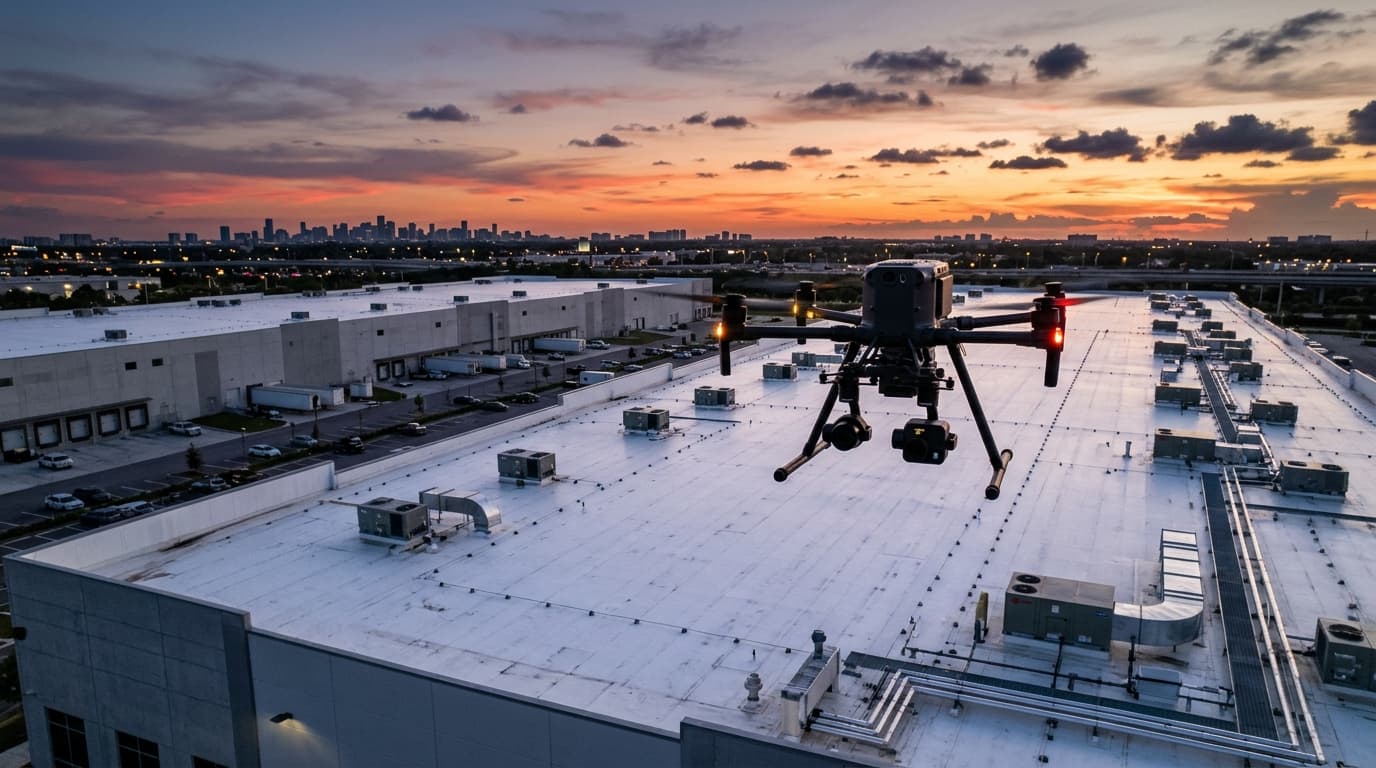
When a 60,000-square-foot distribution warehouse, medical office building, or condominium tower in South Florida develops an interior ceiling leak, the water dripping onto a tenant's desk rarely enters the roof directly above that spot. Water enters through a punctured TPO seam or cracked pitch pan 50 feet away, saturates the underlying polyisocyanurate insulation boards, and travels horizontally along the corrugated steel or concrete deck before finding a joint to drip through. Scheduling an infrared drone commercial roof inspection eliminates guesswork by mapping every square inch of trapped subsurface moisture with millimeter precision.
Beyond emergency leak tracking, commissioning an infrared drone commercial roof inspection is the single most lucrative financial diagnostic tool a commercial property manager or HOA board can deploy. By proving that only 6% of a roof's insulation is wet while 94% remains bone-dry, a certified thermographic survey allows you to perform surgical insulation replacement and qualify for a tax-deductible silicone roof restoration—saving 50% to 65% compared to a full tear-off.
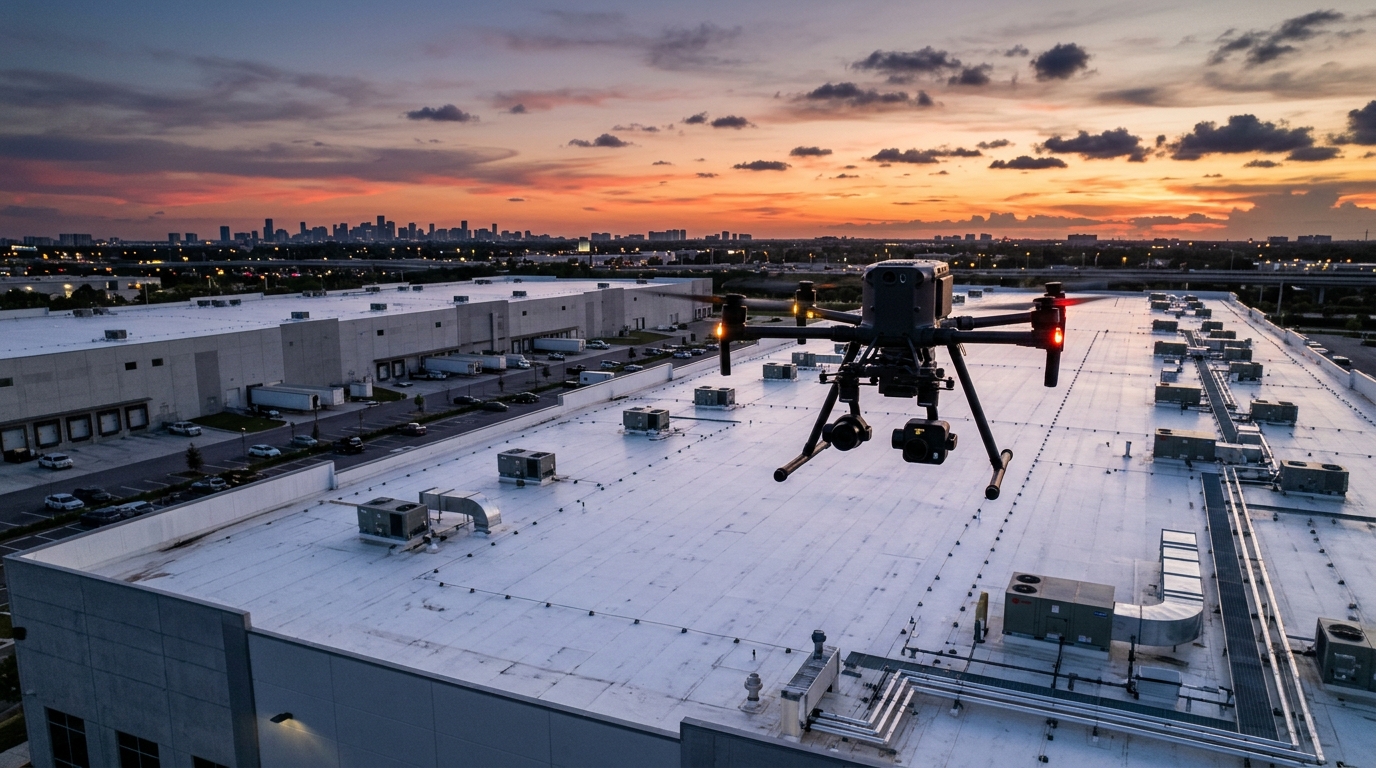
An infrared drone commercial roof inspection uses an aerial radiometric thermal sensor flown 45 to 90 minutes after sunset (per ASTM C1153) to detect solar heat retained by wet roof insulation beneath TPO, PVC, modified bitumen, or built-up membranes. In Florida, thermal moisture mapping satisfies FBC Existing Building § 706.3.1 dryness verification rules and helps commercial owners avoid unnecessary $250,000+ full roof tear-offs.
Prohibits the installation of a new roof covering or liquid-applied restoration system over existing water-soaked low-slope insulation, establishing infrared thermography and physical core verification as the industry standard for moisture delineation.
The Physics of Sunset Thermography: How ASTM C1153 Works
Why can a radiometric thermal camera see water hidden beneath a thick white 60-mil TPO membrane or gravel-surfaced built-up roof in Jupiter, West Palm Beach, or Stuart? The answer lies in specific heat capacity and thermal conductivity:
- Daytime Solar Charging: Throughout a sunny South Florida afternoon, solar radiation heats the flat roof surface to between 120°F and 165°F. Water has a specific heat capacity roughly 4 to 5 times higher than dry closed-cell polyiso foam insulation.
- The Sunset Radiative Window: Once the sun drops below the horizon, the dry sections of the roof radiate their heat into the night sky and cool down within 30 to 45 minutes.
- Thermal Anomaly Mapping: Areas where water has infiltrated beneath the membrane act like a hot water bottle—radiating stored thermal energy for hours after dusk. When our FAA Part 107 pilot flies a calibrated 640×512 radiometric thermal sensor over the roof, wet insulation zones glow bright orange and white against the cool purple/blue background of dry roof assemblies.
- Physical Verification (Tramex & Core Cuts): Per ASTM C1153 protocol, our roofing technicians walk the roof with non-destructive impedance moisture meters (such as a Tramex Dec Scanner) and spray-paint the exact perimeter of each thermal anomaly on the membrane, verifying saturation with targeted core cuts where required.

Diagnostic Comparison: Visual Walk vs. Grid Cores vs. Infrared Drone Scan
| Inspection Method | Coverage Accuracy | Destructive Membrane Holes | Time for 50,000 Sq. Ft. | FBC § 706.3.1 Permit Compliance |
|---|---|---|---|---|
| Standard Visual Roof Walk | < 25% (Misses subsurface wet polyiso) | Zero holes | 2 – 3 Hours | Insufficient for recover permits |
| Traditional 20x20 Core-Cut Grid | ~40% – 55% (Misses leaks between grid points) | 125+ patched holes in your roof | 2 – 3 Days | Accepted, but weakens membrane |
| Nuclear / Capacitance Hand Scan | ~75% – 85% (5x5 ft manual grid) | 2 – 5 verification cores | 1 – 2 Days | Accepted by municipal building depts |
| Radiometric Infrared Drone Survey | 99.4% Full-Pixel Coverage | 1 – 3 targeted verification cores | 45 Minutes flight + report | Gold Standard orthomosaic thermal map |
4 Times Every Commercial Property Owner Should Order an Infrared Scan
- 1. Before Signing a Commercial Real Estate Acquisition (Due Diligence): Never close on an industrial warehouse, retail strip center, or medical plaza in Boca Raton or Palm Beach Gardens relying solely on a daytime visual walk. A $1,800 infrared drone commercial roof inspection during your due-diligence period frequently uncovers $85,000 to $300,000 in saturated insulation, giving you hard leverage for a purchase-price credit.
- 2. Qualifying for a Silicone Roof Coating vs. Full Tear-Off: Before paying $14.00/sq. ft. to tear off an aging TPO or modified bitumen roof, let us scan the deck. If less than 15% of the insulation is wet, we can surgically cut out and replace the wet polyiso boards and apply a 20-year seamless commercial silicone roof restoration at half the cost of replacement.
- 3. Post-Hurricane Insurance Claim Documentation: After a named tropical storm or hurricane, high winds momentarily lift perimeter flashing and force rain underneath the membrane without leaving obvious tears visible to the naked eye. A stitch-mapped orthomosaic thermal report proves sudden moisture intrusion to commercial insurance adjusters.
- 4. Final Quality-Control Audit Before NDL Warranty Expiration: Have your roof scanned 90 days before your builder's turnaround or manufacturer's 15-to-20-year NDL warranty expires so the manufacturer must pay to replace any wet insulation before your coverage lapses.
Ready to see beneath your commercial roof surface without drilling dozens of holes? Schedule a comprehensive commercial roof inspection with Diversified Roofing Solutions today.