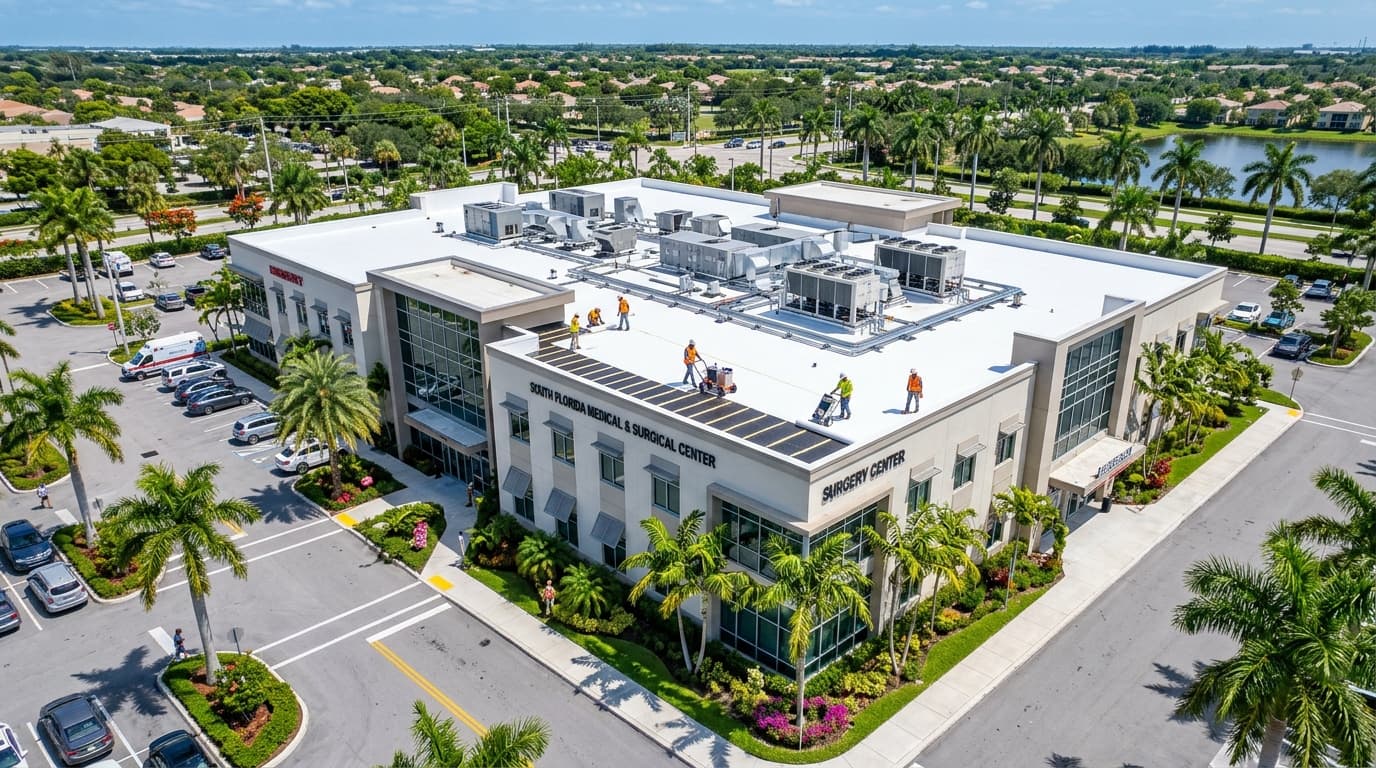
Replacing or restoring the roof over an active warehouse is straightforward; replacing the roof over an occupied outpatient surgery center, oncology clinic, diagnostic MRI suite, or hospital wing in South Florida is a high-stakes clinical operation. Medical facility commercial roofing in Florida demands a completely different engineering playbook—one where a single whiff of solvent fumes drawn into a rooftop fresh-air intake or unexpected hammer-drill vibration above an operating room can shut down tens of thousands of dollars in scheduled patient procedures.
Across Palm Beach County and the Treasure Coast—from the medical corridors surrounding Jupiter Medical Center and Wellington Regional to St. Mary's, Good Samaritan, and Cleveland Clinic Martin Health—healthcare facility directors trust specialized contractors who understand ICRA (Infection Control Risk Assessment) protocols, zero-VOC low-odor adhesive chemistry, and ASCE 7 Risk Category III/IV hurricane engineering. Here is how we execute medical facility commercial roofing in Florida with zero disruption to patient care.
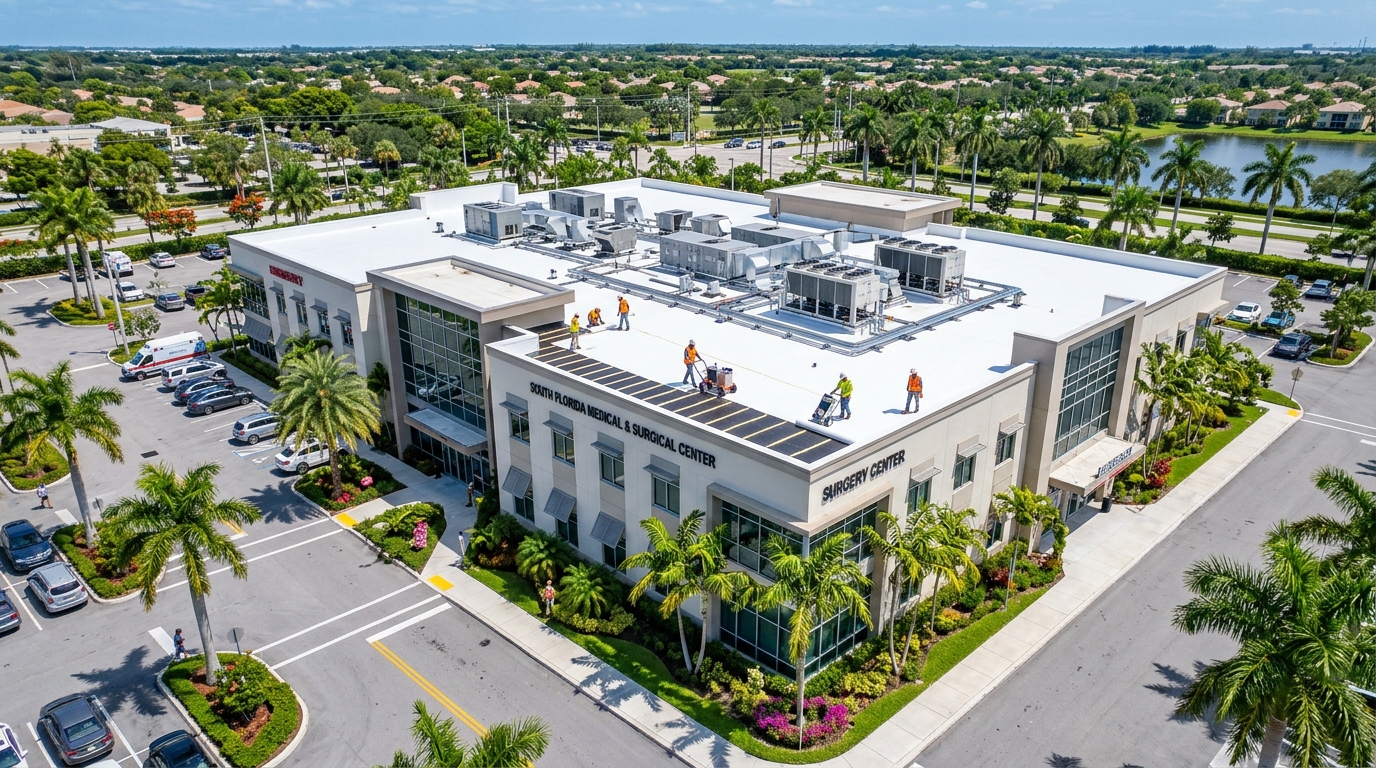
Medical facility commercial roofing in Florida requires zero-VOC, odorless two-component urethane adhesives, heat-welded 80-mil TPO/PVC or 100%-solids alkoxy silicone systems, and quiet foam-adhered insulation to prevent fumes or vibrations from disrupting occupied clinical spaces. Healthcare buildings classified under FBC Risk Category III or IV must also meet elevated 180–200+ MPH hurricane uplift pressures and strict ICRA airborne dust controls.
Establishes heightened hurricane wind velocity pressures for healthcare facilities, continuous positive-pressure HVAC air-quality protection, and strict airborne particulate containment during building envelope modifications.
The 4 Non-Negotiable Pillars of Healthcare & Medical Office Roofing
When a medical real estate REIT, hospital engineering director, or physician group in Jupiter, West Palm Beach, Boca Raton, or Stuart plans a roof replacement, four clinical risks must be engineered out of the project before day one:
- 1. Zero-Odor / Zero-VOC Fresh-Air Intake Protection: Medical buildings rely on rooftop Dedicated Outdoor Air Systems (DOAS) that pull 100% outside air directly from the roof surface into sterile corridors. Traditional solvent-based yellow contact adhesives, asphalt primers, and torch-down modified bitumen emit pungent volatile organic compounds (VOCs) that trigger immediate patient and staff nausea. We utilize 100% solvent-free, zero-odor low-rise polyurethane foam adhesives, water-based primers, and hot-air welded seams—backed by activated carbon filter blankets over active air intakes.
- 2. Acoustic & Vibration Isolation Over Clinical Bays: Driving 15,000 steel screws through a corrugated metal deck or rotary-hammering into structural concrete directly above an active MRI scanner, dental chair, or microsurgery suite is unacceptable during patient hours. By using ribbon-adhered low-rise foam to bond both the tapered polyiso insulation and a 115-mil or 135-mil fleece-backed TPO/PVC membrane, we eliminate 90% of mechanical fastener noise while actually increasing wind uplift resistance.
- 3. ICRA Infection Control & Sub-Deck Dust Containment: Tearing off an aged roof can flex steel decking and shake loose decades of dust or Aspergillus mold spores sitting on top of interior acoustic ceiling tiles. Our healthcare protocol coordinates interior ceiling plenum barriers, deck flute sealing, and surgical daily dry-ins so no moisture or particulates ever enter clinical zones.
- 4. Risk Category III & IV Hurricane Uplift Engineering: Under FBC Table 1604.5, hospitals and emergency surgical facilities are Risk Category IV structures (180–205 MPH design wind speeds in South Florida), and large outpatient medical clinics are often Risk Category III. Corner and perimeter wind uplift zones require tighter ribbon spacing, heavy-duty 1/2-inch high-density cover boards, and ANSI/SPRI ES-1 tested stainless fascia/coping metal.

Standard Commercial Roofing vs. Medical Facility Roofing Protocol
| Engineering Parameter | Standard Retail / Warehouse Roofing | Medical & Healthcare Facility Protocol | Clinical Benefit |
|---|---|---|---|
| Membrane Attachment | Solvent-based contact adhesive or thousands of screws | Zero-VOC Low-Rise Foam + Fleece-Back TPO/PVC | Zero odor in HVAC intakes & 85% quieter |
| Silicone Coating Chemistry | Standard oxime cure (slight vinegar odor) | 100% Solids Low-Odor Alkoxy Medical-Grade Silicone | Can be applied during full Monday–Friday clinic hours |
| ASCE 7 Wind Load Category | Risk Category II (165–175 MPH) | Risk Category III / IV (180–205+ MPH) | Keeps facility operational immediately after a Category 4 storm |
| Medical Gas & Exhaust Curbs | Standard pitch pans | PMMA Fleece Liquid Flashing & Stainless Hoods | Zero leaks around oxygen lines, bio-exhaust & chillers |
| Staging & Crane Safety | Standard parking lot closure | Phased off-hours crane lifts + patient drop-off protection | Uninterrupted ADA patient access & ambulance bays |
Schedule a Clinical-Grade Roof Assessment
Whether you manage a multi-tenant medical office building (MOB), an ambulatory surgery center, or an assisted living facility, our commercial roofing specialists deliver turnkey, odor-free roof replacements and commercial silicone restorations engineered around your patients' schedule. Contact Diversified Roofing Solutions today to arrange a confidential site walk and infrared moisture scan.