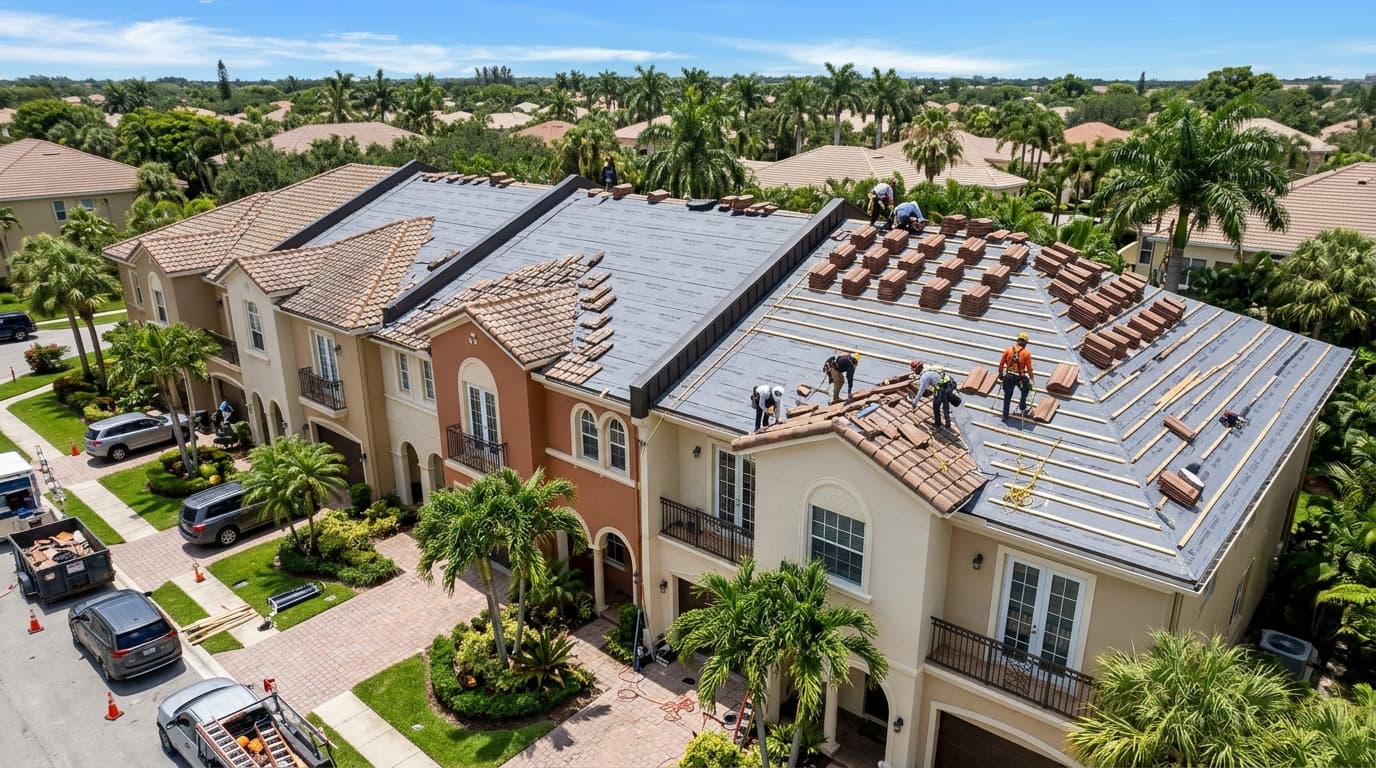
If you own a fee-simple townhome, attached patio villa, or paired zero-lot-line duplex in Jupiter (such as Abacoa), Wellington, Boynton Beach, Boca Raton, or Stuart, discovering that your homeowners insurance carrier requires a new roof often triggers an immediate legal and engineering headache: Your roof is physically connected to two, four, or six of your neighbors' roofs! Navigating a townhome shared roof replacement in an HOA in Florida requires untangling your community's Declaration of Covenants (CC&Rs), Florida Building Code party-wall fire rules, and waterproof boundary tie-in engineering.
Many townhome buyers assume that because the exterior stucco and lawn are maintained by the HOA, the association also pays for the roof. While some "roof-maintained" HOAs do hold roof reserves, thousands of Chapter 720 fee-simple townhome and villa associations across Palm Beach and Martin County leave 100% of roof replacement responsibility on the individual lot owner. Here is how a townhome shared roof replacement in an HOA in Florida works—and how to prevent the dreaded "party-wall boundary leak."
In a townhome shared roof replacement in an HOA in Florida, legal payment responsibility is dictated by your recorded Declaration of Covenants (Chapter 720 vs. Chapter 718). When individual fee-simple townhome or villa owners must replace their own roof section independently, the contractor must execute an engineered party-wall tie-in flashing over the masonry fire wall to prevent water from migrating horizontally from a neighbor’s older 20-year-old underlayment onto your new roof deck.
Governs structural fire-rated separation walls between attached townhome units (either continuous masonry parapet walls or fire-retardant-treated plywood sheathing within 4 feet of the party wall) and establishes HOA architectural control boundaries.
The Engineering Challenge: Slicing a Roof Down an Invisible Lot Line
When a single townhome or paired-villa owner in Jupiter, Palm Beach Gardens, or Delray Beach hires a roofer to replace only their unit's roof while the attached neighbor refuses to replace theirs, look at what happens along the dividing line:
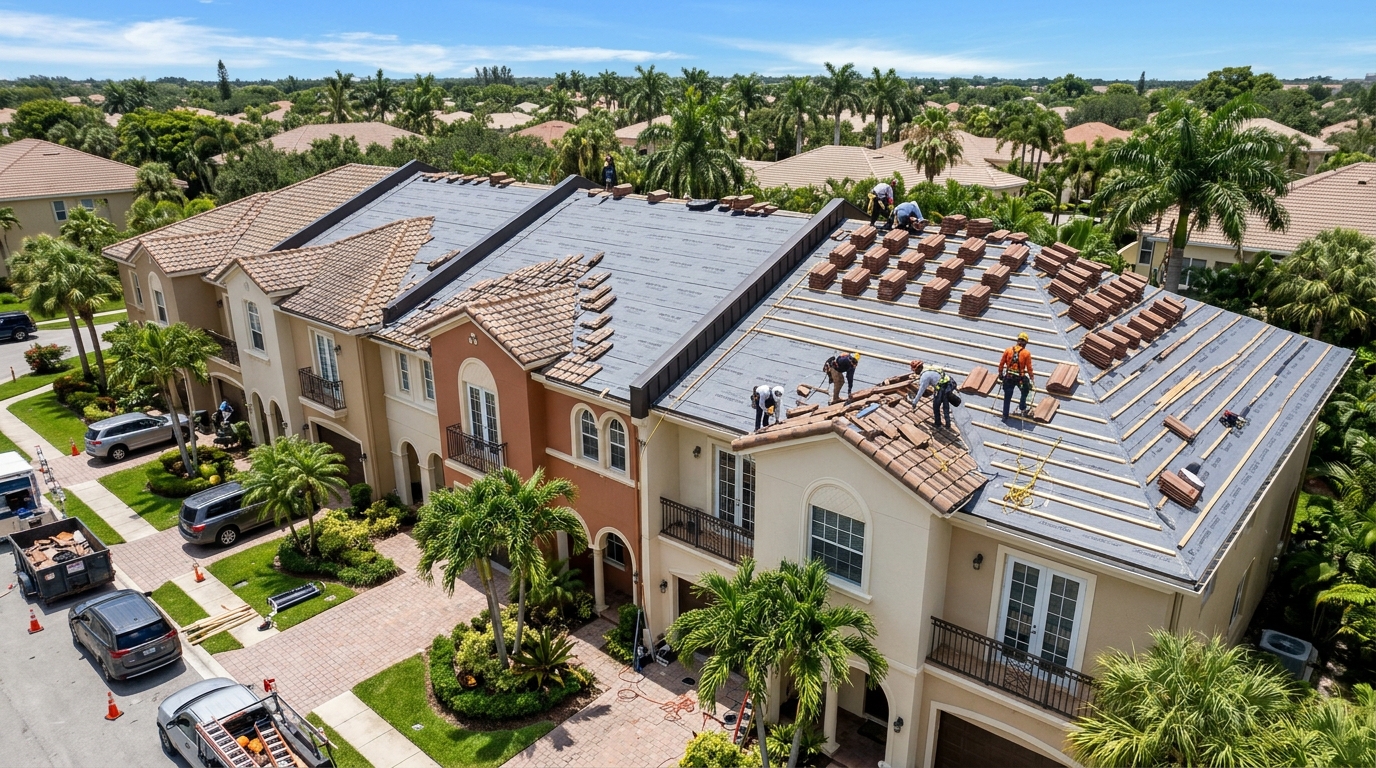
- Flush Continuous Deck vs. Raised Parapet Firewall: On some townhomes, a concrete block parapet wall rises 18 inches above the roofline between units—making separation easy. However, on most South Florida Mediterranean tile villas and townhomes, the masonry fire wall stops flush with the underside of the plywood roof deck, and the concrete barrel tiles run continuously across all units without a break!
- Horizontal Water Migration from the Neighbor's Old Roof: Suppose your new roof has a fresh peel-and-stick secondary water barrier, but your neighbor's side still has 22-year-old dry-rotted felt paper. If the roofer simply butts your new underlayment against the neighbor's rotten paper along the party wall, any leak 6 feet over on your neighbor's roof will run sideways under the tiles and pour straight into your living room!
- The Diverter Saddle & Interlocking Tile Tie-In Solution: To make an individual townhome reroof 100% watertight, our crews open a 24-inch transition zone over the masonry party wall, install a custom-bent 26-gauge galvanized or stainless steel water-diverter cant/channel flashing embedded in elastomeric modified bitumen mastic that blocks lateral water migration from the neighbor's deck, and precision-interlock the matching HOA-approved tile or shingle profile.

Townhome & Villa Shared Roof Replacement Scenarios Compared
| Ownership & Project Scenario | Who Signs & Pays? | Party-Wall Leak Risk | Estimated Cost Savings | Insurance Underwriting Impact |
|---|---|---|---|---|
| Condominium Association (F.S. § 718) | Association Board (Common Element / SIRS) | Zero (Whole building replaced at once) | Bulk multi-building commercial pricing | Master policy covers structure; owners carry HO-6 |
| Single Townhome / Villa Tie-In (Solo Owner) | Individual Homeowner (with HOA ARC permit) | Moderate unless engineered water-stop diverter installed | Standard single-unit pricing + tie-in flashing labor | Unlocks immediate HO-3 renewal & Form OIR-B1-1802 credits |
| Coordinated Multi-Neighbor Replacement (2–6 Units) | Neighboring Owners Together (Separate contracts, 1 permit phase) | Zero (Continuous monolithic underlayment across party walls) | Save $1,800 – $3,500 per unit (No tie-in labor + bulk crane/dumpster) | Every participating neighbor gets a 100% seamless FBC roof |
How We Help Townhome Neighbors Coordinate & Save Thousands
Whenever a townhome or paired-villa owner in Palm Beach or Martin County calls Diversified Roofing Solutions for a residential roof replacement, we offer a complimentary "Neighbor Coordination Package":
- Free Adjacent Roof Inspections: With your permission, we inspect your attached neighbors' roof slopes and provide each owner with a side-by-side photo report showing the age and condition of their underlayment—plus how much they will save on both construction and Florida homeowners insurance by reroofing together.
- Turnkey HOA ARC Packet Preparation: We prepare the unified HOA Architectural Review Committee submission—complete with Florida Product Approval (NOA) numbers, exact tile/shingle samples, and our $2M commercial liability certificate naming your HOA as additionally insured.
- Individual Financing & Separate Invoicing: Even when 4 attached townhome neighbors replace their shared roof simultaneously to capture bulk savings, each homeowner receives their own separate contract, municipal permit sign-off, OIR-B1-1802 Wind Mitigation report, and optional roof financing plan.
Own a townhome or villa in South Florida? Check your baseline estimate on our Roofing Cost Calculator or contact our Jupiter team for a party-wall inspection.