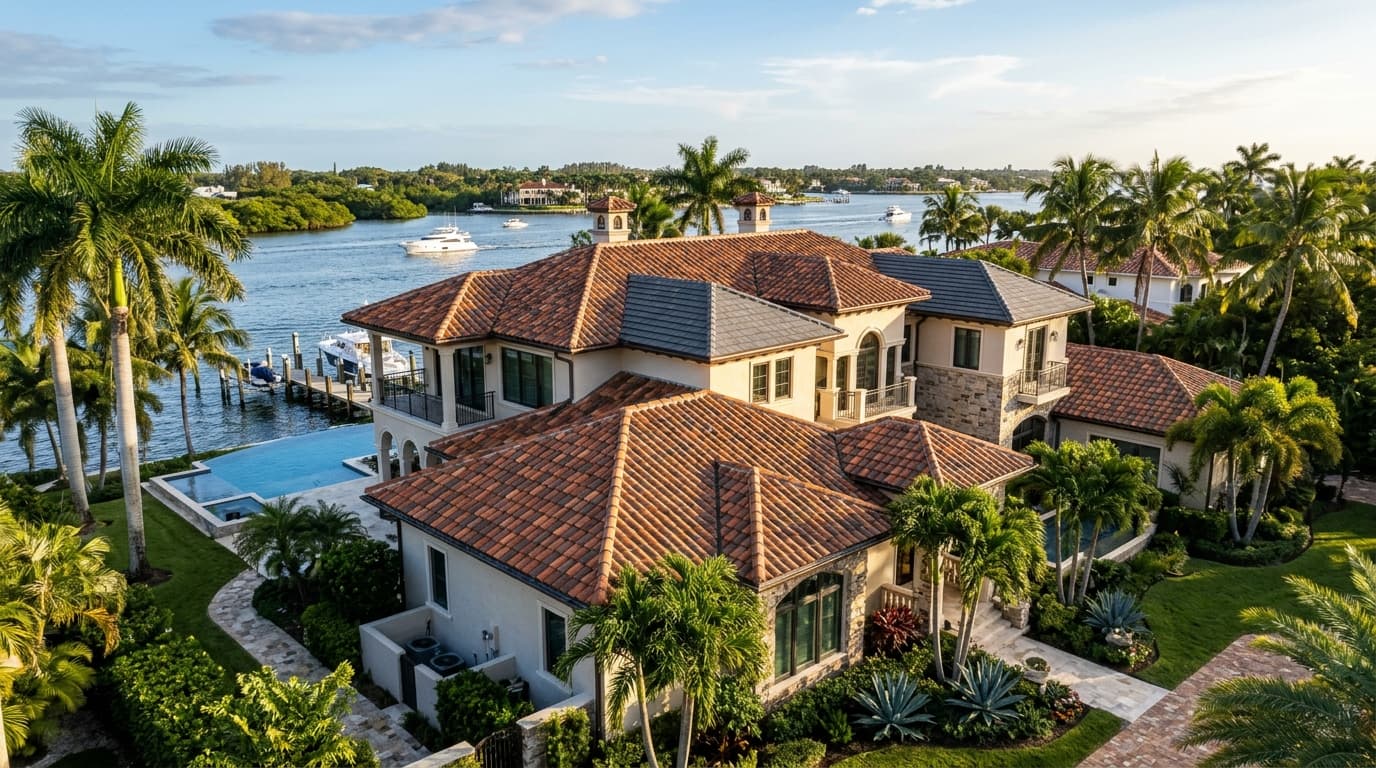
Nothing defines the architectural character of Palm Beach Island, Jupiter, Boca Raton, and Stuart quite like a classic Mediterranean barrel or modern flat profile tile roof. Yet when homeowners sit down to select materials for a custom build or full replacement, they immediately encounter a pivotal question: concrete vs clay roof tiles in South Florida—which material actually delivers superior hurricane durability, curb appeal, and long-term financial value?
From a distance of 50 feet, a newly installed concrete S-tile roof and a Spanish clay barrel roof can look nearly identical. Ten years later under South Florida's relentless UV index, salt spray, and tropical deluges, the physical differences between concrete vs clay roof tiles in South Florida become unmistakably clear. Here is our master roofer's breakdown of how both systems perform in our coastal climate.
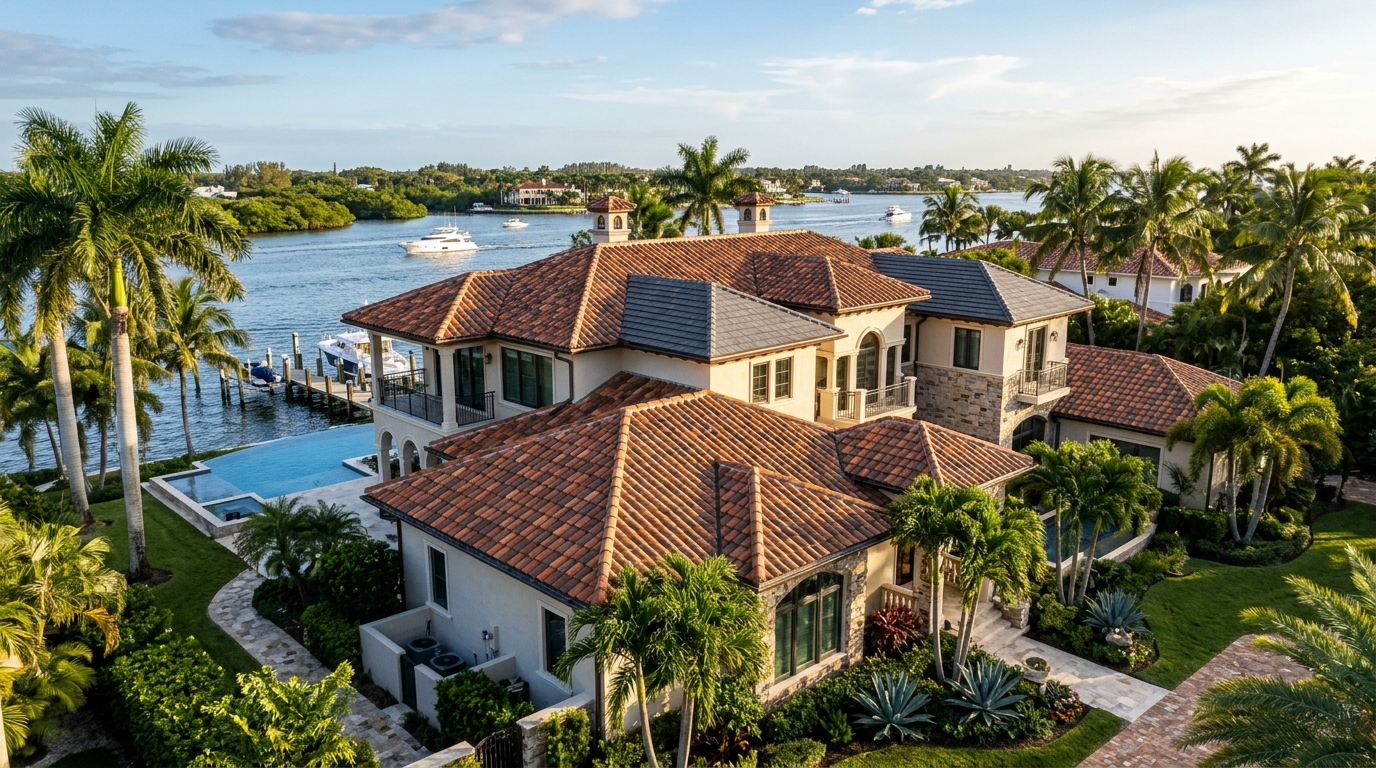
When comparing concrete vs clay roof tiles in South Florida, concrete tiles ($8.50–$13.50/sq. ft. installed) offer 30%–40% lower upfront cost, higher compressive foot-traffic strength, and wide availability in modern flat and S-tile profiles. Kiln-fired clay tiles ($13.50–$22.00/sq. ft. installed) are 20%–30% lighter, absorb half as much water, are 100% immune to coastal salt-air spalling, and retain their natural baked-in terracotta colors for 75+ years without fading.
Governs minimum water-absorption limits (ASTM C1167 for clay; ASTM C1492 for concrete), structural dead-load engineering, and wind-uplift paddy foam / mechanical screw fastening schedules across Florida wind zones.
Manufacturing Physics: Why Clay and Concrete Age Differently
To understand why these two materials behave so differently over a 30-year span in Jupiter or Delray Beach, you have to look at how they are made:
- Extruded Concrete Tiles (Eagle, Westlake Royal/Boral, Entegra, Crown): Concrete tiles are extruded under high pressure from sand, Portland cement, water, and synthetic iron-oxide pigment, then cured in warm humidity chambers at roughly 140°F. Color is applied either as a surface slurry coat or mixed through the cement body. Over 12 to 18 years of intense Florida UV exposure and acid rain, calcium carbonate slowly leaches to the surface (a chalky phenomenon called efflorescence), gradually softening bright reds and terra-cottas into muted pastel tones.
- Kiln-Fired Clay Tiles (Santafe, Tejas Borja, Ludowici, Verea): Natural clay is molded and fired inside high-temperature kilns at 1,850°F to 2,100°F. This vitrification process fuses the clay minerals into a ceramic, glass-like skin. Because the color comes from natural mineral oxides vitrified throughout the clay body (or ceramic glaze), a clay tile roof on a waterfront estate in Palm Beach will look just as vibrant in year 50 as it did on day one.

Side-by-Side Comparison: Concrete vs. Clay Roof Tiles in South Florida
| Engineering & Cost Metric | Extruded Concrete Roof Tiles | Kiln-Fired Natural Clay Roof Tiles | Winner for South Florida |
|---|---|---|---|
| Installed Cost (Per Sq. Ft.) | $8.50 – $13.50 / sq. ft. ($850–$1,350/sq) | $13.50 – $22.00 / sq. ft. ($1,350–$2,200/sq) | Concrete Tile (Best upfront value) |
| Material Lifespan | 40 – 50 Years | 75 – 100+ Years | Clay Tile (Generational longevity) |
| Dry Weight (Per 100 Sq. Ft.) | 900 – 1,100 lbs / square | 650 – 850 lbs / square | Clay Tile (20–25% less structural load) |
| Water Absorption Rate | 8% – 13% by weight (Gains weight in rain) | 2% – 6% by weight (Vitrified low porosity) | Clay Tile (Resists algae & moisture) |
| UV Color Retention (20 Yrs) | Moderate (Develops natural patina / chalking) | Permanent (Zero UV pigment fading) | Clay Tile (Unmatched HOA curb appeal) |
| Coastal Salt-Air Immunity | Good (Requires sealer near direct ocean surf) | 100% Immune (Impervious to salt spalling) | Clay Tile (Ideal for waterfront estates) |
| Foot-Traffic Breakage Resistance | High (Thick, dense flat & barrel profiles) | Moderate (True 2-piece barrel requires walk pads) | Concrete Tile (Higher point-load strength) |
How Polyurethane Foam Adhesives Changed Hurricane Survival
Historically, Florida homeowners worried that clay tiles were more fragile in hurricanes than concrete tiles. Under modern Florida Building Code TAS 101 and TAS 102 standards, how the tile is fastened matters far more than whether it is clay or concrete.
When our crews install residential tile roofing in Palm Beach and Martin County, we utilize two-component polyurethane structural roof tile adhesive (such as ICP Polyset AH-160 or DuPont TileBond) combined with stainless-steel eave/perimeter fasteners. Instead of relying on two brittle nail holes at the top of the tile, high-density foam paddies bond the nose and body of each tile together into a monolithic, interconnected shell capable of withstanding wind uplift pressures exceeding 170 to 190+ MPH.
Don't Forget the Most Important Layer: Your Underlayment
Whether you choose concrete or clay, remember that roof tiles are a decorative and mechanical wind/UV shield—your underlayment is what keeps water out of your house. Installing 75-year Spanish clay tiles over a cheap synthetic sheet is a costly mistake. We pair every tile installation (and every tile roof lift and relay) with heavy-duty, polyester-reinforced, self-adhering modified bitumen peel-and-stick underlayment so your waterproof barrier lasts 25 to 30+ years.
Compare concrete and clay pricing for your exact roof footprint today using our interactive Roofing Cost Calculator.